


The Man Who Sold The Moon
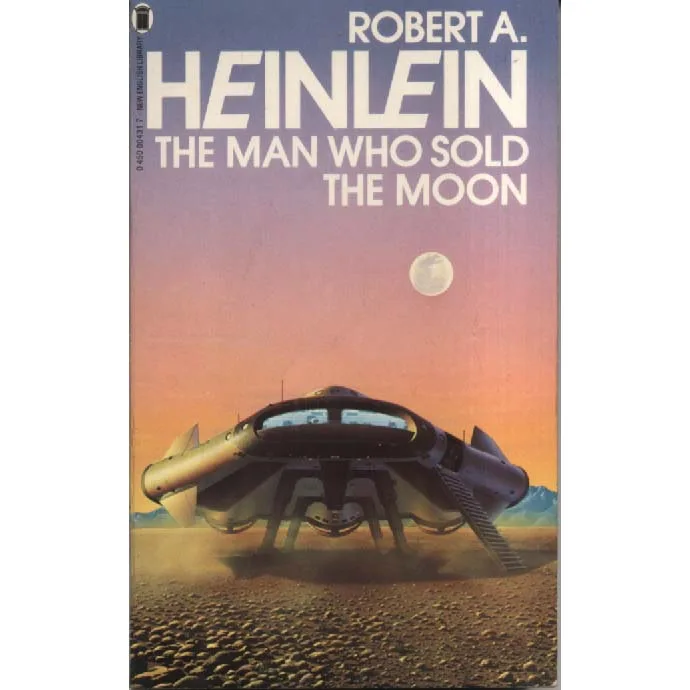
Publisher: New English Library
Format: Paperback
ISBN: 0450004317
The Man Who Sold the Moon (1983) by Robert A. Heinlein
New English Library | ISBN: 0450004317 | Condition: Good
There are ambitious men, there are extraordinarily ambitious men, and then there is D. D. Harriman, a gentleman who looks up at the Moon and sees not a romantic celestial body, nor an inspiration for poets and lovers, but a magnificent business opportunity. In The Man Who Sold the Moon, Robert A. Heinlein explores what might happen if the conquest of space were entrusted not to governments, scientists or idealistic explorers, but to an industrialist with an enormous fortune, an even larger imagination and absolutely no intention of allowing something as trivial as practical impossibility to interfere with his plans.
First published as a collection in 1950, The Man Who Sold the Moon brings together some of Heinlein’s early Future History stories, those wonderfully inventive tales in which humanity gradually develops the technology, institutions and occasional common sense required to venture beyond Earth. The title story concerns the aforementioned Delos David Harriman, a wealthy entrepreneur obsessed with putting a man on the Moon, preferably while ensuring that he retains a substantial financial interest in the entire enterprise.
Harriman is a fascinating creation, combining the visionary enthusiasm of a pioneer with the commercial instincts of a man who would cheerfully sell advertising space on the Pearly Gates if someone could arrange a reliable delivery service. He knows that reaching the Moon will require staggering amounts of money, sophisticated engineering and a willingness to gamble everything on an endeavour that most sensible investors would consider an excellent way of becoming considerably poorer.
His solution, naturally, is to sell the Moon before anybody has actually reached it.
And why not? After all, human history contains countless examples of people enthusiastically buying things they have never seen, cannot possibly use and whose ownership rests upon legal arrangements of highly questionable validity. Compared with some modern financial products, the Moon is at least a tangible object, even if delivery might prove a little inconvenient.
What follows is a thoroughly entertaining exploration of the commercial, political and technological obstacles standing between humanity and the lunar surface. Harriman must persuade investors, manipulate competing interests, navigate legal complications and somehow finance an undertaking that has no established market, no proven technology and a destination approximately a quarter of a million miles away. It is, in many respects, the ultimate speculative business venture, with the additional inconvenience that a catastrophic failure may involve considerably more than an unfavourable quarterly report.
The collection also includes other stories charting humanity’s technological development and the social consequences of scientific progress. In Let There Be Light, the promise of revolutionary energy technology encounters the sort of commercial resistance that might be expected when an invention threatens to make established industries rather less profitable. The Roads Must Roll imagines a future transportation system based upon enormous moving roadways, a splendid concept that combines engineering ingenuity with the alarming possibility of an industrial dispute bringing an entire civilisation to a standstill.
Elsewhere, The Long Watch introduces a young military officer confronted with a dangerous moral dilemma involving nuclear weapons and the abuse of political power, while Requiem returns to Harriman’s lifelong obsession with space travel and provides a poignant conclusion to a dream that has consumed his existence. Together, these stories reveal Heinlein’s extraordinary ability to combine technological speculation with questions of personal responsibility, individual ambition and the sometimes uncomfortable relationship between progress and the people expected to pay for it.
One of the great pleasures of reading Heinlein’s early science fiction is encountering a future imagined before the real space age had properly begun. The author was writing at a time when the Moon remained a distant, largely unexplored world, rather than somewhere humanity had already visited, planted flags and left behind an assortment of expensive equipment. His predictions do not always correspond with what eventually happened, but that is part of the fascination. Science fiction is not obliged to provide an accurate engineering forecast, particularly when the imaginary future is frequently more entertaining than the one we actually received.
There is also something deliciously ironic about the commercialisation of space. Heinlein imagined private enterprise struggling to make spaceflight possible, while subsequent history saw governments spend enormous sums reaching the Moon, only for private companies decades later to rediscover that launching things into space might be an excellent business. Harriman, one suspects, would have regarded the modern space industry with considerable satisfaction, although he would undoubtedly have demanded a controlling interest and complained bitterly about the regulatory paperwork.
The book also raises an amusing question concerning the ownership of celestial bodies. Who, precisely, possesses the authority to sell the Moon? Can someone purchase a crater? Is there a property boundary between the Sea of Tranquillity and the Ocean of Storms? And if a lunar estate agent advertises a desirable plot with uninterrupted views of Earth, who is responsible for maintaining the access road? These are the sorts of problems that might become surprisingly important once humanity has finished the comparatively straightforward business of getting there.
Beneath the humour and commercial speculation, however, lies something rather more moving. Harriman’s ambition is not simply an exercise in acquiring wealth. He genuinely believes in humanity’s destiny beyond Earth, and his personal longing to reach the Moon gives the story an emotional foundation that prevents it from becoming merely an amusing account of interplanetary capitalism. He is a dreamer who happens to understand balance sheets, which is an unusual and potentially formidable combination.
For admirers of Robert A. Heinlein, The Man Who Sold the Moon is particularly rewarding because it demonstrates the foundations of his elaborate Future History and the themes that would dominate much of his later writing. Technological innovation, individual determination, political manipulation, economic freedom and the obligations of those possessing extraordinary power all feature prominently. There is also the familiar Heinlein conviction that human beings are capable of remarkable achievements, provided they can occasionally be persuaded to stop obstructing one another.
This 1983 New English Library edition is a splendid example of vintage science-fiction publishing, from an era when paperback novels were still expected to fit comfortably into a pocket rather than arrive accompanied by a cinematic universe, twelve streaming adaptations and a promotional campaign involving collectible figurines. It offers the opportunity to revisit an imagined future conceived long before the modern commercial space industry began turning some of Heinlein’s more extravagant ideas into recognisable business proposals.
This copy is offered in Good condition by Crappy Old Books, a bookseller that has yet to acquire the Moon, although enquiries from suitably wealthy investors will naturally receive careful consideration. Until such time as lunar property development becomes a practical sideline, the business will continue concentrating on more modest acquisitions, principally elderly books that deserve another opportunity to entertain someone.
An excellent addition to any collection of classic science fiction, particularly for readers interested in the early space age, Heinlein’s Future History, the relationship between capitalism and technological progress, or the peculiar determination of human beings to establish ownership rights over things they have not yet managed to reach.
It is also a remarkably appropriate book for the modern age, when billionaires are once again spending fortunes on rockets, space tourism and the prospect of establishing commercial operations beyond Earth. The principal difference is that Harriman managed to pursue his ambitions without maintaining a social media account through which to explain them to the rest of us every fifteen minutes.
A wonderful journey into the days when the Moon was still an impossible dream, the future seemed infinitely promising, and the greatest obstacle to conquering space was finding someone gullible enough to finance the expedition.
And should anybody offer to sell you a particularly attractive section of lunar real estate, remember the oldest rule in property investment: always inspect the premises before handing over your money. Especially when the nearest solicitor is 238,000 miles away.
Keep browsing: See more Science-Fiction books Other books by Robert A Heinlein
